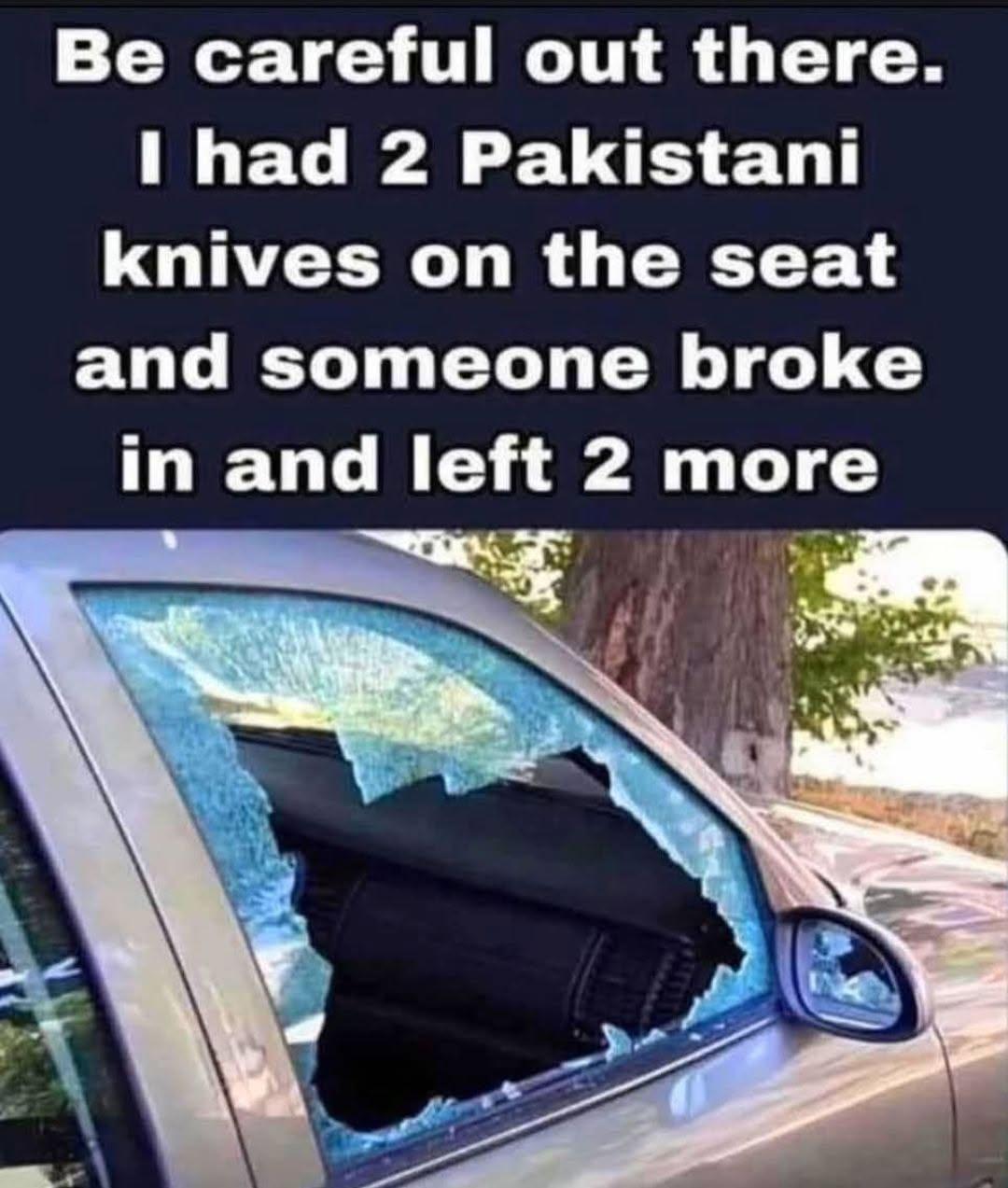
The meme says it plainly: "I had 2 Pakistani knives on the seat and someone broke in and left 2 more." A r/knives post paired that joke with a photo of a shattered car window this week, and the thread did what it always does, because the punchline rests on an assumption everybody in the hobby repeats. The assumption is that Pakistani blades are uniformly junk. The place behind the punchline is Wazirabad, Punjab, a city of more than a thousand manufacturing units that has exported blades for over a century and a half.
Turn the joke around and the numbers are not what most people expect. Pakistan's cutlery exports were worth about $55 million in the eleven months to May 2025 according to Pakistan Bureau of Statistics figures, hunting knives in patterned steel are a core export line, and the main markets are the United States, Germany, the United Kingdom, Saudi Arabia and Afghanistan. A trade association for the blade industry, HSKSAAP, was formally registered in 2025 and claims more than 250 member companies shipping to over 30 countries.
| Wazirabad blade industry at a glance | Figure |
|---|---|
| Manufacturing units | 1,000+ (HSKSAAP) |
| Association member companies | 250+ (est. 2025) |
| Export destinations | 30+ countries |
| Cutlery exports, 11 months to May 2025 | ~$55 million (PBS) |
| Heritage | 150+ years |
| Main export markets | US, Germany, UK, Saudi Arabia, Afghanistan |
What the cluster actually looks like
A Pakistan Business Council and Engineering Development Board study describes the trade as a fragmented cottage industry rather than a factory system: registered firms sitting next to informal workshops, with larger companies subcontracting stages of production to smaller units that often skip quality control entirely. Two knives from the same shelf can differ. Branding is nearly absent, so many blades carry neither a maker's name nor a country of origin, and the stainless steel mostly arrives from China rather than from domestic mills. The Cutlery Institute of Pakistan, a training center set up in the city in 2001, is described in the same study as no longer functioning.
Older industry reporting gives a sense of scale. Roughly a quarter of Wazirabad's population has been tied to the trade directly or indirectly, annual output has run near three million cutlery pieces plus well over a million swords, and about 95 percent of swords and hunting gear leave the country.
Why the reputation, and what is true
The reputation is earned at the low end, where eBay and Etsy listings sell decorative "Damascus" that is only acid-etched pattern on plain steel. The buyer's test from the trade itself is straightforward: real pattern-welded steel shows the figure on the spine and in the edge bevel, not just on the flats, and an etched fake will not. At the skilled end of the cluster the work is genuinely hand-forged, and HSKSAAP's stated program is exactly this gap, pushing quality standards, member verification and trade-show presence at SHOT Show and IWA Nuremberg to drag the industry from unmarked commodity goods toward recognizable names.
Ask what steel a blade is made from; sellers who know the answer usually know the workshop
Check for gaps or movement where blade meets handle
Sight along the edge for waves, chips or flat spots
For Damascus, look for the pattern on the spine and bevel, not just the flats
None of this makes the meme wrong at the level it aims at. A buyer with no interest in vetting individual pieces should not buy unmarked Pakistani "Damascus" at any price, and the fake-etched trap is everywhere precisely because the good workshops do not brand their output.