The chikiri lever is the part that gives a higonokami away: the flat leaf of metal pressed against the spine that swings the blade open on a friction pivot, no lock, no detent, no click. A wave of 2026 releases keeps that lever's silhouette but quietly deletes its job, replacing friction with a liner lock and adding a flipper the 1899 original never carried.
The original versus the remake
Nagao Kanekoma still makes the real thing: a brass-handled friction folder in blue paper steel, running $48.99 for the 120mm and $35 for the 90mm. It is a gentleman's folder, legally carryable in places that ban locking blades, and completely dependent on the user's grip for safety. Designer Goran Mihajlovic's modernized version keeps the flat slab handle and the chikiri lever's look, then bolts on the features the original refused: a liner lock behind the blade and a top flipper for one-handed opening. The result carries like a traditional knife but works like a modern EDC folder.
Kansept's build, the premium read
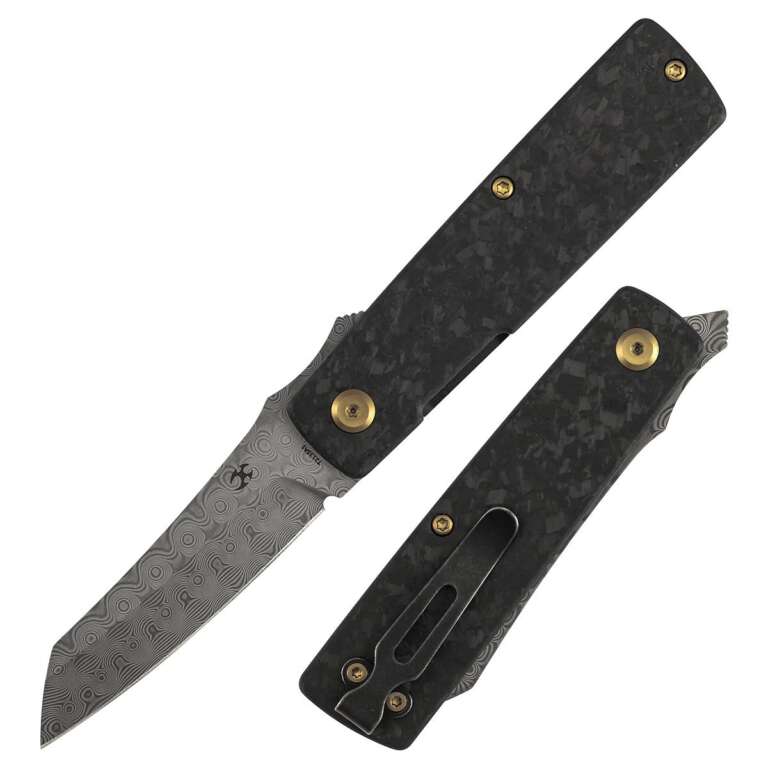
The Kansept Higonokami T2135A1 runs the design in its dress configuration: a 3.01-inch Damascus blade ground as a modified reverse tanto, shred carbon fiber scales over the slim frame, 6.94 inches open and 3.42 ounces on the scale. The liner lock and top flipper make it a genuine one-handed carry knife rather than a display friction folder. At $129.89 it sits above the standard higonokami price band, and the Damascus pattern plus carbon fiber are what the extra money buys.
Tenable's build, the value read
The Tenable Higonokami B2135A5 runs the same Mihajlovic silhouette in working clothes: a 3.02-inch D2 blade under a gray coating, light sand G10 scales, and a $56.89 sticker. A Damascus variant of the Tenable sells at $89.89, still forty dollars under the Kansept. The G10 build stays closer to a tool than a keepsake, and the coated D2 blade suits buyers who intend to use rather than display. Where this goes next is the interesting part. Böker's Sanjo and Kihon lines borrow Japanese silhouettes with different executions, and Cold Steel revived the Mackinac Hunter with Japanese AUS-10A, so the broader Japanese-design wave has room to keep expanding. Will more brands pick up the higonokami specifically and its lock-and-flipper modernization template, or will the silhouette stay a two-brand niche in 2027 catalogs?