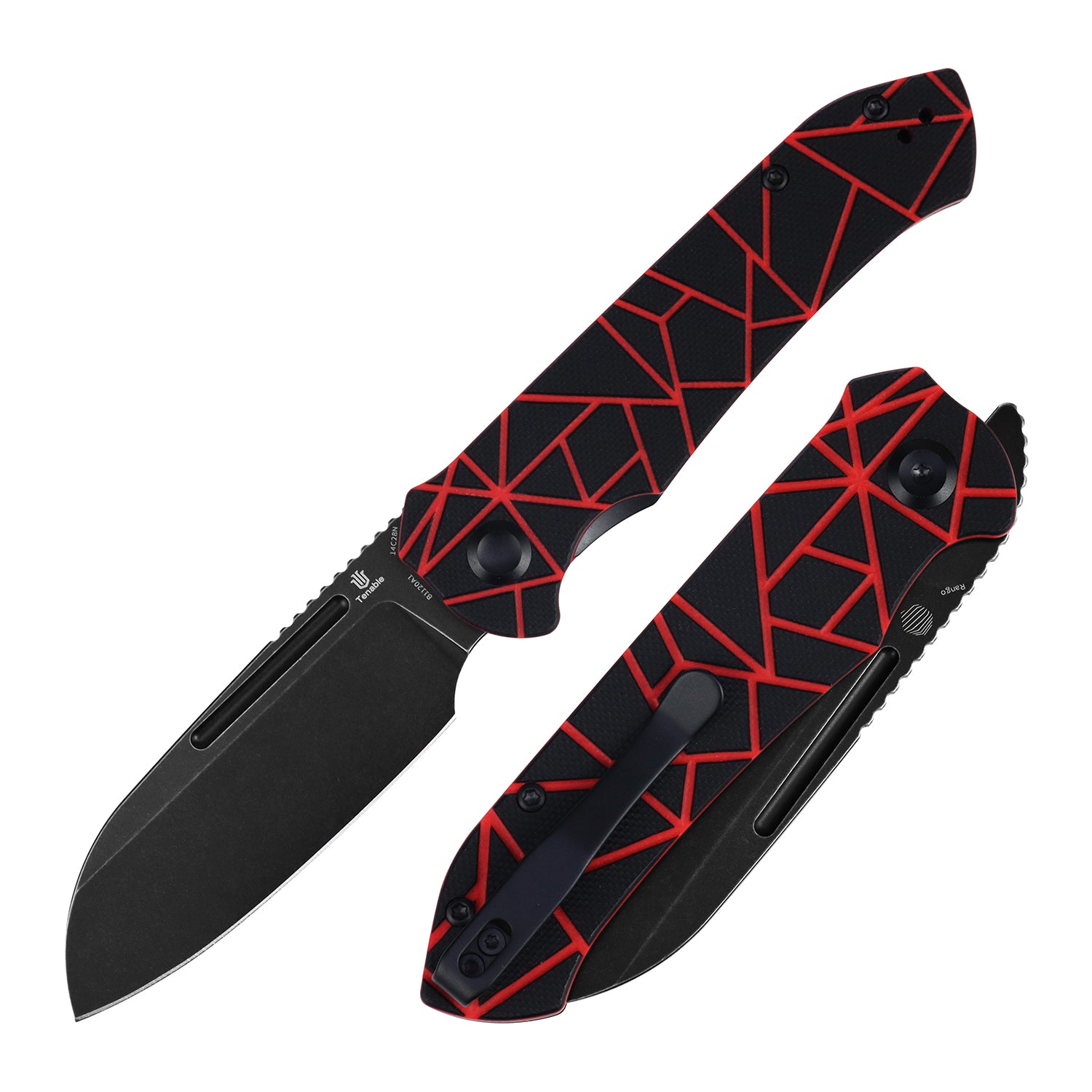
Tenable sits in the same Chinese production ecosystem as WE and CIVIVI, and the brand's recent strategy has been to publish designer collaborations at prices its parent company's flagship line cannot reach. The Rango, model B1120A1, is the latest example: a Steven Kastner design with a 3.41-inch sheepsfoot blade in 14C28N, black and red G10 scales, a liner lock, and a $65.89 price. Kastner runs Saje Knives out of Washington State and draws on mosaics and mathematics for his handle patterns, which explains the geometry printed across this one.
A Sheepsfoot With a Rounded Tip
The blade shape is the reason to look at this knife. A sheepsfoot runs a straight edge up to a spine that curves down to meet it, and Tenable rounds the tip rather than leaving a point. That rounding is not cosmetic: it makes the knife dramatically safer to use near hands, hoses and wire, and it means the tip will not skate off a flat surface and stab something unintended.
The cost is piercing ability, and buyers should be honest about whether they need it. A sheepsfoot is a cutting shape, not a stabbing one — it excels at draw cuts through rope, strap and cardboard, where the straight edge keeps a constant contact angle. At 0.118 inches thick with a flat grind, the Rango is ground for slicing rather than for splitting. A fuller machined into the blade removes weight and gives the thumb a purchase point for two-handed opening.
The Mohawk Flipper and the Handle Pattern
Tenable calls the deployment tab a "Mohawk" flipper — a top-mounted, front-adjacent lever that sits above the pivot rather than behind it. The practical effect is that the thumb can reach it without repositioning the hand, and the flipper disappears into the handle's silhouette when the knife is closed, which is why the design looks cleaner than most front flippers. Front flippers are less forgiving than rear tabs, though: they reward a practiced thumb and punish a hesitant one, and buyers coming from a standard flipper should expect a few days of fumbling.
The handle is where Kastner's background shows. The mosaic-inspired pattern is molded or machined into black and red G10, and Tenable claims the geometry is shaped to complement the grip rather than simply decorate it. Whether the pattern functions as texture or only as graphics is hard to judge from photographs, but the handle does have a palm swell and a forward choil that should keep the hand from sliding onto the edge.
Spec | Detail |
|---|---|
Blade steel | 14C28N, 58-60 HRC |
Handle material | Black and red G10 |
Overall length | 7.92 in / 201.2 mm |
Blade length | 3.41 in / 86.5 mm |
Blade thickness | 0.118 in / 3.0 mm |
Weight | 4.26 oz / 120.9 g |
Lock type | Liner lock |
Designer | Steven Kastner (Saje Knives) |
Price (MSRP) | $65.89 |
Status | Available on Tenable's site |
14C28N at $66 Is the Right Call
Sandvik 14C28N has become the default budget stainless for good reason. It is a nitrogen-enhanced steel with about 0.62 percent carbon and 14 percent chromium, formulated for knife blades rather than inherited from bearing stock. Its virtues are balanced: corrosion resistance high enough for a sweaty pocket or a fishing vest, toughness high enough to take a thin edge without chipping, and grindability that keeps production costs — and therefore prices — low.
At 58-60 HRC, the Rango's edge will hold up through typical EDC work and restore quickly on a ceramic hone. It will not match the more expensive particle-metallurgy steels on abrasive wear; knives in CPM-20CV or MagnaCut at twice the price will out-cut it on quantities of cardboard. For a $66 knife used a few times a day, that is the correct trade rather than a compromise. The 4.26-ounce weight is on the heavier side for a G10 liner lock of these dimensions, largely because of the steel liners, and buyers who prioritize a light carry should note it.
What $66 Buys in This Segment
This is the most competitive price point in the folding knife market, and the Rango's case has to be made on design rather than specification. CIVIVI's Elementum and Praxis lines offer comparable steel and better-known lock geometry at similar money; QSP's hawkbill and sheepsfoot models undercut it; Kershaw's imports sit below it with worse steel.
The differentiator is the combination of a designer name, a sheepsfoot blade with a rounded tip, and the top-mounted flipper — a configuration that is genuinely uncommon at this price. Someone who wants a utility knife that will not puncture a bag of fertilizer and who likes a front-flipper action will find very little competition. Someone who wants a drop point with a thumb stud has a hundred alternatives.
The Verdict
The Rango is a well-specified budget folder with one genuinely distinctive blade shape and one genuinely distinctive opening method. Kastner's geometric handle treatment gives it an identity that most $66 knives lack, and 14C28N is the right steel for the price rather than a cost-cut.
It is listed at $65.89 on Tenable's site. Tenable also offers the model in alternate configurations, including a damascus blade and aluminum handles, so buyers should confirm the variant — B1120A1 is the 14C28N and G10 version specifically.