Every few months a new blade steel arrives with a specification sheet that implies the previous generation is obsolete. A recent analysis from Larrin Thomas at Knife Steel Nerds makes the case that this framing is backwards. Steel development, he argues, has always been a negotiation between properties that pull against each other, and the interesting advances come from rebalancing those tradeoffs rather than from discovering an alloy that wins on every axis at once.
The piece is a useful corrective for anyone who buys knives on steel names alone, and it explains why some grades that look mediocre on paper keep showing up in expensive production knives.
The Property List Is Longer Than Buyers Think
The properties that matter in a blade include hardness, toughness, wear resistance and corrosion resistance — the four that dominate enthusiast discussion. The full list is longer: cost, forgeability, grindability, polishability, sharpenability, availability and marketability all shape whether a steel reaches production at all.
Some are manufacturer concerns that matter more than buyers realize. A steel that is cheap per pound but slow to grind can cost more to use than a premium grade, and an unfamiliar steel adds perceived exclusivity while forcing a brand to spend money explaining why it is good.
Availability is the least discussed and possibly the most decisive. Many alloys exist on paper and are no longer produced, and even current grades are often not rolled to the thin stock blades require. A grade common in one country may be unobtainable to a maker in another, and importing adds freight and tariff costs. Origin claims add a further layer, since an American-made knife generally needs domestic steel behind the label.
The Matched Set, Still the Best Mental Model
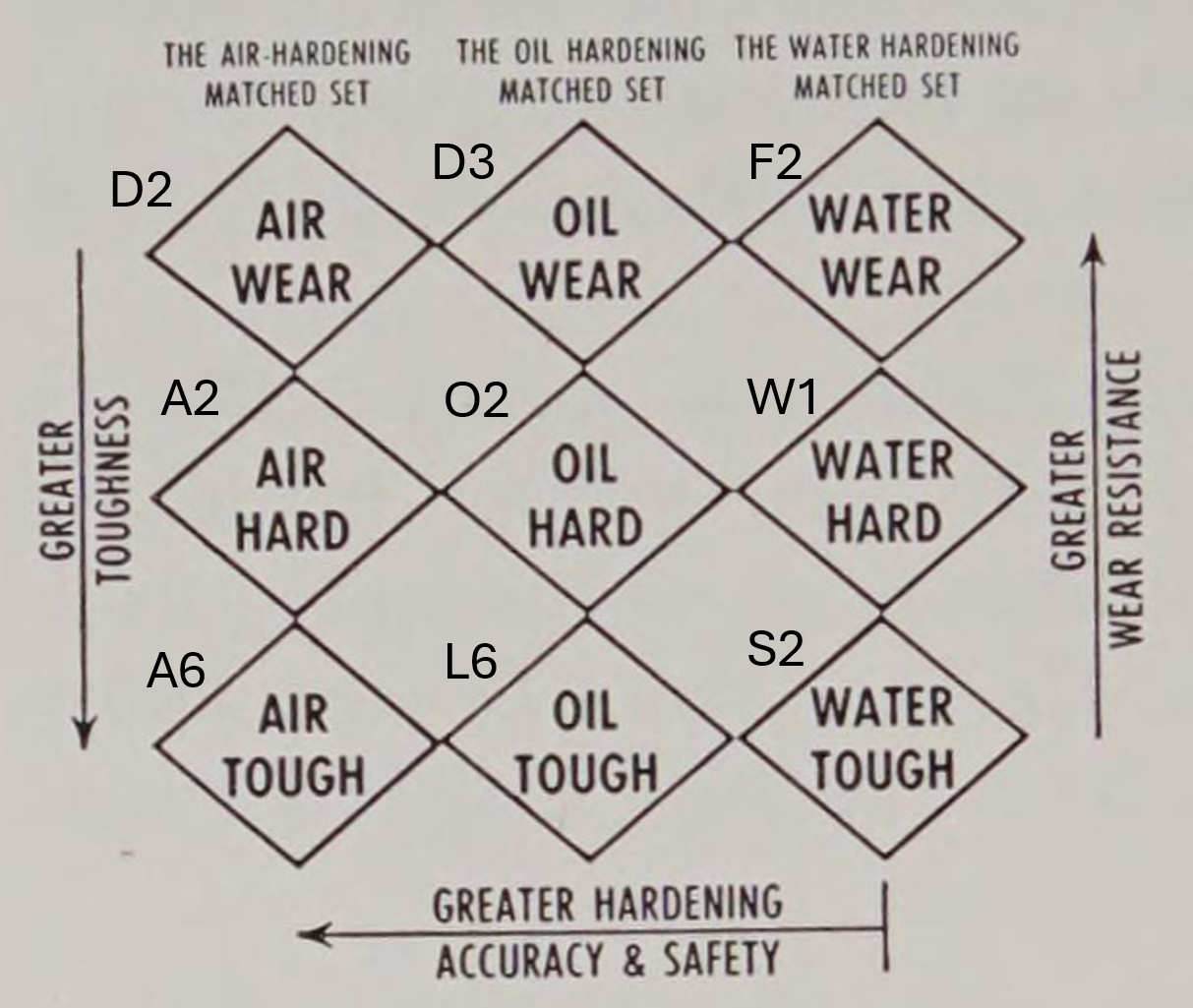
The most useful idea in the article is nearly a century old. Carpenter Steel introduced its “Matched Set Method” in 1935, grouping tool steels into families optimized for wear resistance, toughness, or a balance of the two — with hardenability as a secondary axis. The specific grades have changed many times since, but the structure has not.
That structure explains why arguments about adjacent grades are usually wasted energy. Choosing between two steels in the same family is a fine-tuning decision. Choosing between a high-toughness grade and a high-wear grade is the decision that actually changes how a knife behaves, because the two goals are fundamentally opposed: the carbides that resist abrasion are the same features that initiate cracks under impact.
Why the Big Jumps Came From Process, Not Recipes
The historical pattern is consistent. Before the late 1800s, steel was essentially iron and carbon. Adding tungsten produced hard carbides for wear resistance; adding chromium produced air-hardening grades and, eventually, stainless steels — the first commercial one of which was actually pitched as a knife steel. Those were generational changes, and they came from understanding alloying rather than from tweaking a formula.
The next jump was powder metallurgy, adopted for knife steels in the 1960s and 1970s. Conventional casting produces large, segregated carbides that make a blade brittle and difficult to grind. Atomizing the melt into powder and consolidating it keeps carbides small and evenly distributed, which is what made very high-vanadium grades practical in production knives at all. Modern high-wear stainless such as S90V and S110V exist because of that process, not because someone found a new element.
The current generation follows the same logic. Grades like MagnaCut and the newer MagnaMax are not breakthroughs in any single property; they are re-balancings that push one axis, usually toughness or corrosion resistance, without surrendering as much of the others as older grades did. The marketing calls that innovation. Metallurgically it is optimization, and optimization is what a mature industry does.
What This Means for Buyers
Three practical conclusions follow. First, pick the family before the grade: decide whether the knife needs impact resistance, abrasion resistance, or corrosion resistance, then look at steels that are strong in that category. Second, treat small differences between adjacent grades as noise — heat treatment and edge geometry will dominate real-world performance. Third, treat availability and cost as legitimate signal: a steel that appears in a $60 knife and a $400 knife is probably there because it is well balanced and easy to source, not because the budget brand got lucky.
The Verdict
The next decade of knife steel is likely to look like the last one: incremental rebalancing within established families, plus occasional process improvements that make previously impractical grades manufacturable. That is less exciting than a miracle alloy, but it is more useful, because it means buyers can make decisions on geometry, heat treatment and intended use instead of waiting for the next name on a specification sheet.
The full analysis, including the historical charts and property comparisons, is published at Knife Steel Nerds.