A wet hand on a Micarta handle, a thumb pressed behind a finger guard, and five inches of blade going through a piece of green wood. That is the whole brief for the KNX, and KA-BAR did not add anything to it.
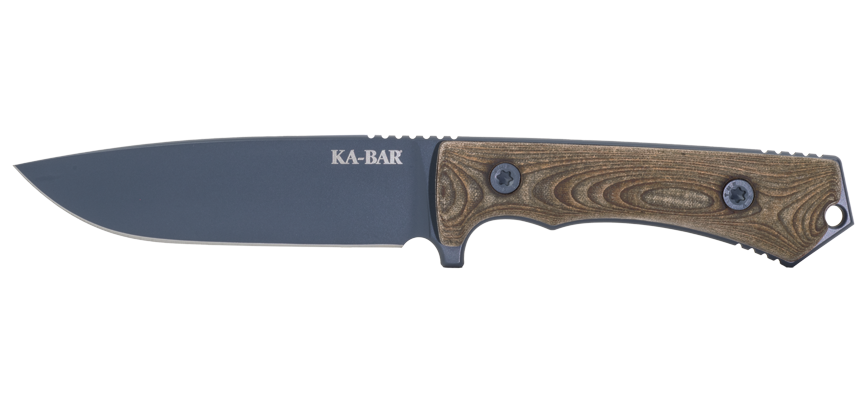
The company confirmed this week that the KNX is now shipping in the United States. It is not built in Olean, New York. The knife comes out of Euro Blade Worx in Znojmo, Czechia, a sister company to KA-BAR and to Spartan Blades, run by designer Ondřej Němec.
That factory is the real story. Euro Blade Worx gives all three brands a European production floor, so designs reach European dealers without export paperwork, and KA-BAR can add a fixed blade to the catalog without waiting on capacity in New York. The KNX went on sale in Europe last year before this month's US release, which reverses the usual direction of these launches.
The pattern is new. A 5-inch drop point with a full flat grind running clean to the edge, no swedge, no serrations. Steel is 1095 Cro-Van, the carbon mix that has sat on the company's fighting knives for decades. It holds an edge well enough for field work and gives it back in two minutes on a pocket stone. It also stains. A knife left in a wet sheath overnight will show it, and that is the trade for steel that will not chip when it meets bone or a knot.
Handle geometry is where the design does its thinking. The forward finger guard is deep enough that the index finger drops behind it and stays there, which holds the rest of the hand in place during a hard push cut. Scales are natural canvas Micarta, left rough enough to grip when wet and dark enough not to show sap. The whole knife weighs 8 ounces.
The sheath is molded Kydex. It grips the handle rather than the blade, so the edge never drags on the way out and the finish does not get chewed up by repeated draws. There is no fire steel loop, no sharpening stone pocket and no MOLLE panel. Buyers who want a kit knife will need to look elsewhere.
At this size the field is crowded. ESEE builds 1095 blades a quarter inch thick for people who intend to baton. Buck's 119 has been the default American hunting knife for sixty years on a softer heat treatment and a much lower price. Fallkniven and Bark River sit above it with laminate and tool steels. The KNX does not try to out-tough any of them. It sits in the middle with a flat grind that slices better than a saber grind and a handle drawn around a human hand rather than a machining setup.
US pricing has not been published, and KA-BAR has not said how many units make up the first run. It ships now, in one blade length, with Micarta and Kydex and nothing else.