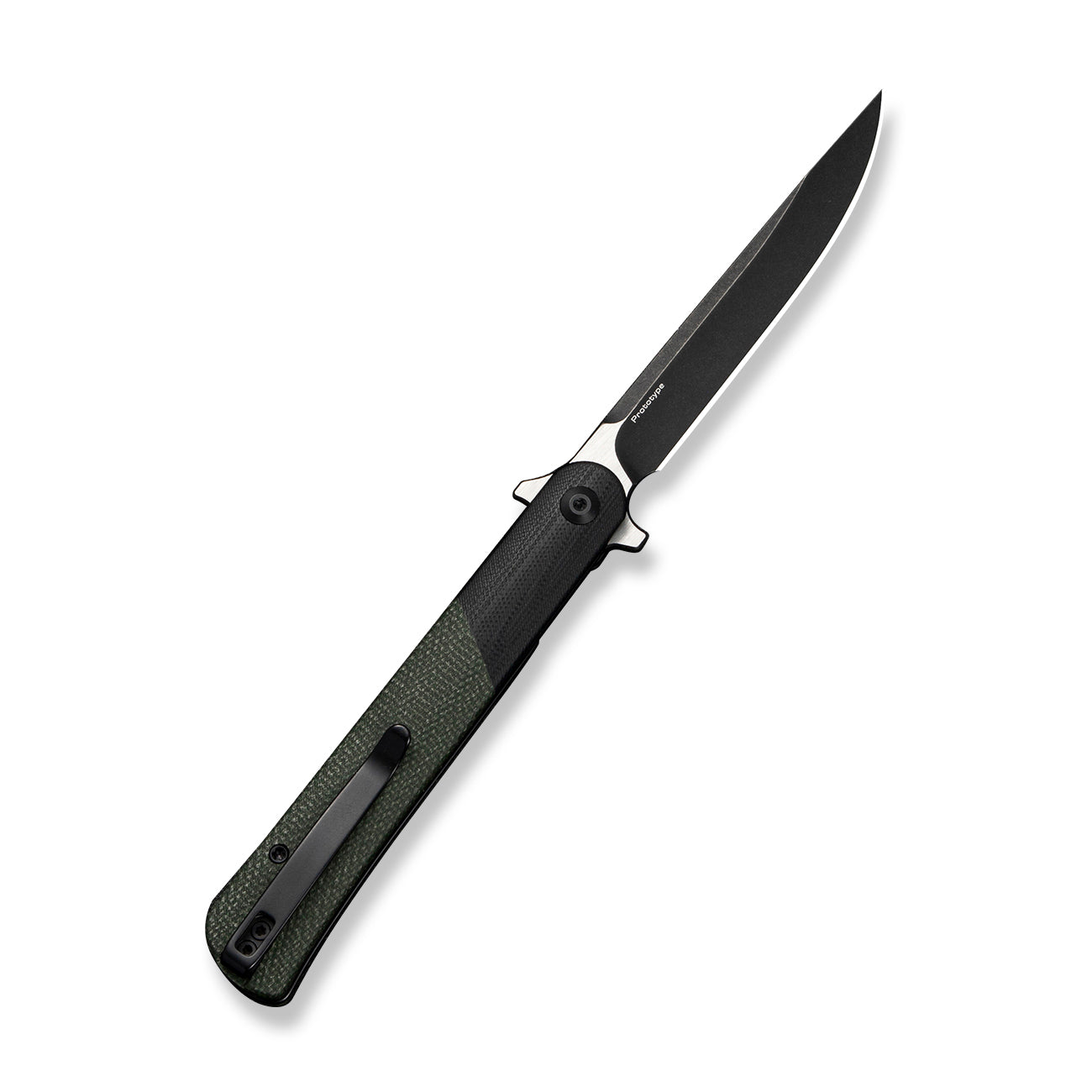
A knife named after an estoc should be a spike. The historical weapon carried no cutting edge anywhere along its length. It was a stiffened rod of steel with a sharpened point, built to push through plate armor that had already laughed off a conventionally ground longsword. Anyone expecting CIVIVI's new C26009 to arrive as a 4-inch needle will be disappointed in the first photograph. It has a flat of satin blade, a drop point, and a hollow grind.
KnifeNews, which broke the story on November 2, put the original weapon's oddity plainly.
It was quite literally built different, with no live edge at all, but rather a thickened rod-like blade with a sharpened point only, designed to pierce through plate mail that would baffle traditionally-ground longswords.
So the Estoc is a name, not a blueprint. What CIVIVI did keep is the silhouette, and that is where the knife gets interesting.
What survived from the sword
Two things. The first is the flipper tab, which is shaped to read as the crossguard of a traditional estoc. It sits at the pivot like a small horizontal bar rather than a hook, and the finger falls onto it from the same angle a hand would fall onto a guard. The second is the handle: 5.03 inches closed, straight along its spine, wide enough that four fingers land without hunting for a choil.
Specimens of the real estoc from the 14th through 17th centuries varied in size, but an outsized grip and a simple crossguard were common to most of them. CIVIVI followed that logic far enough to make a 9.13-inch knife that weighs 3.58 oz in the heavier of its two builds. A 4.1-inch blade at that weight is unusual, and most of it comes from the 0.13-inch stock and the 0.6-inch handle thickness.
The numbers
| Spec | C26009 Estoc |
|---|---|
| Blade | 4.1 in / 104.2 mm, Nitro-X7, hollow grind, drop point |
| Hardness | 60-62 HRC (Sample1) / 61-63 HRC (Sample2) |
| Overall / closed | 9.13 in / 5.03 in |
| Blade stock | 0.13 in / 3.2 mm |
| Weight | 3.31 oz / 3.58 oz |
| Lock | Liner lock, caged ceramic bearings |
| Clip | Tip-up, left or right, stainless |
| Price | $87 and $99.70 as listed |
Nitro-X7 is the higher-performance variant of Nitro-V, and CIVIVI is running it at 60 to 63 HRC depending on the build. That is a nitrogen-bearing stainless in the same family as the Nitro-V that has become common on $70 to $120 folders, so the edge-holding expectation is modest but the corrosion resistance is not a worry. Hollow grind plus a 4.1-inch length makes this a slicing profile, not a pry bar.
Two sample builds, both sold out
CIVIVI currently lists the Estoc as Sample1 and Sample2 rather than as a production line. Sample1 pairs green canvas micarta over G10 with a black stonewashed blade and satin flats at $87, 3.31 oz. Sample2 goes black and silver with a fiberglass fabric handle, full satin finish, and 3.58 oz at $99.70. Both pages read sold out as of this writing, while KnifeNews reported the model as available now.
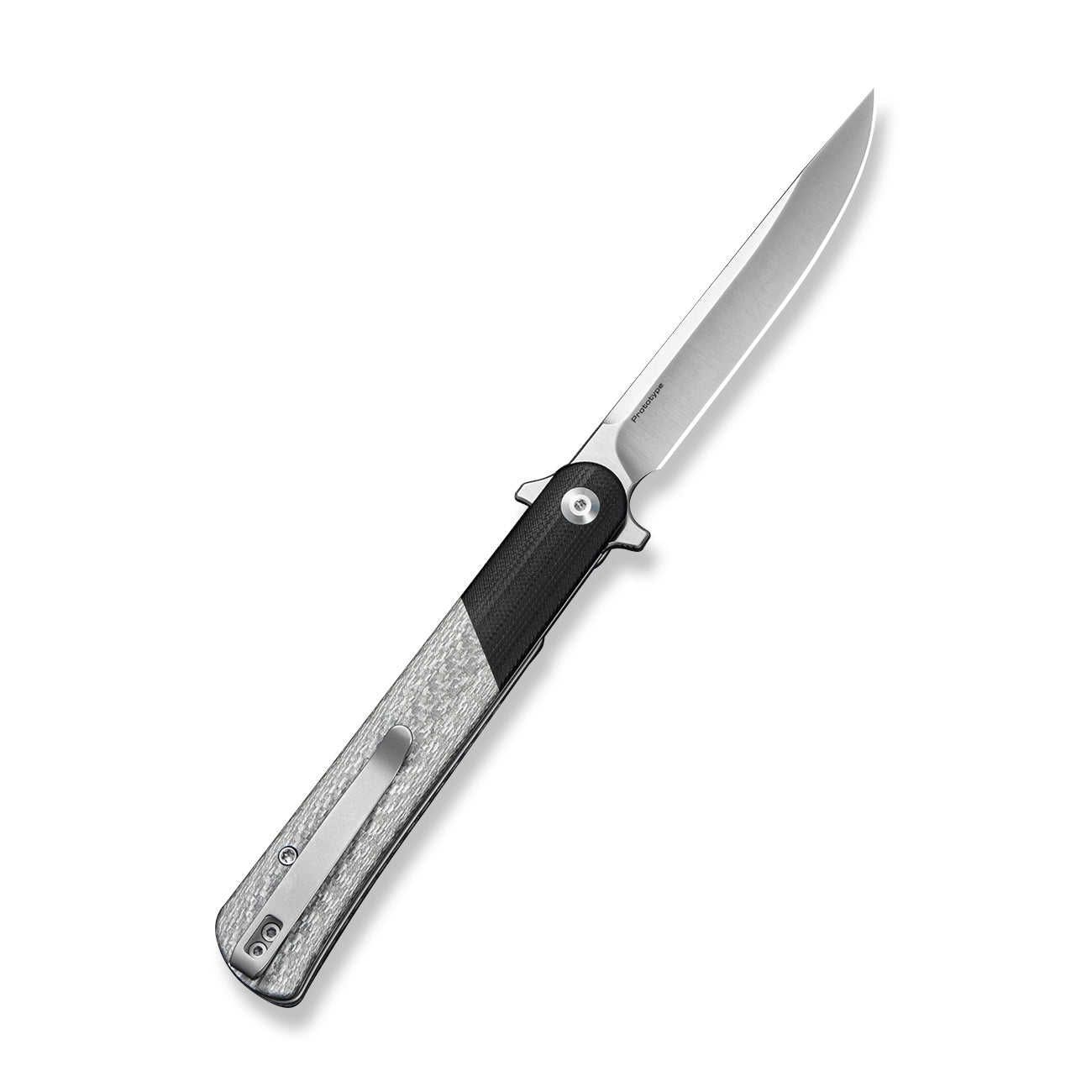
Keep an eye on whether the production version keeps Nitro-X7 or drops to 14C28N to hold the price under $100, whether the left-hand clip and liner lock combination stays, and whether the 4.1-inch blade survives intact. Sword names sell, but a 4-inch blade in a $90 knife is a harder commercial case than the same knife at 3.5 inches, and CIVIVI's own catalog has plenty of those.