The red anodized ring around the pivot screw is doing more work than any other part of this knife. Everything else on the new Böker Heckler & Koch FD04 and FD05 is black: black titanium-coated D2, black aluminum scales, a black H&K logo. The ring, a matching red backspacer and a lanyard hole are the only color on either knife, and that one accent is what separates these from the pile of blacked-out budget folders that all look identical in a product grid.
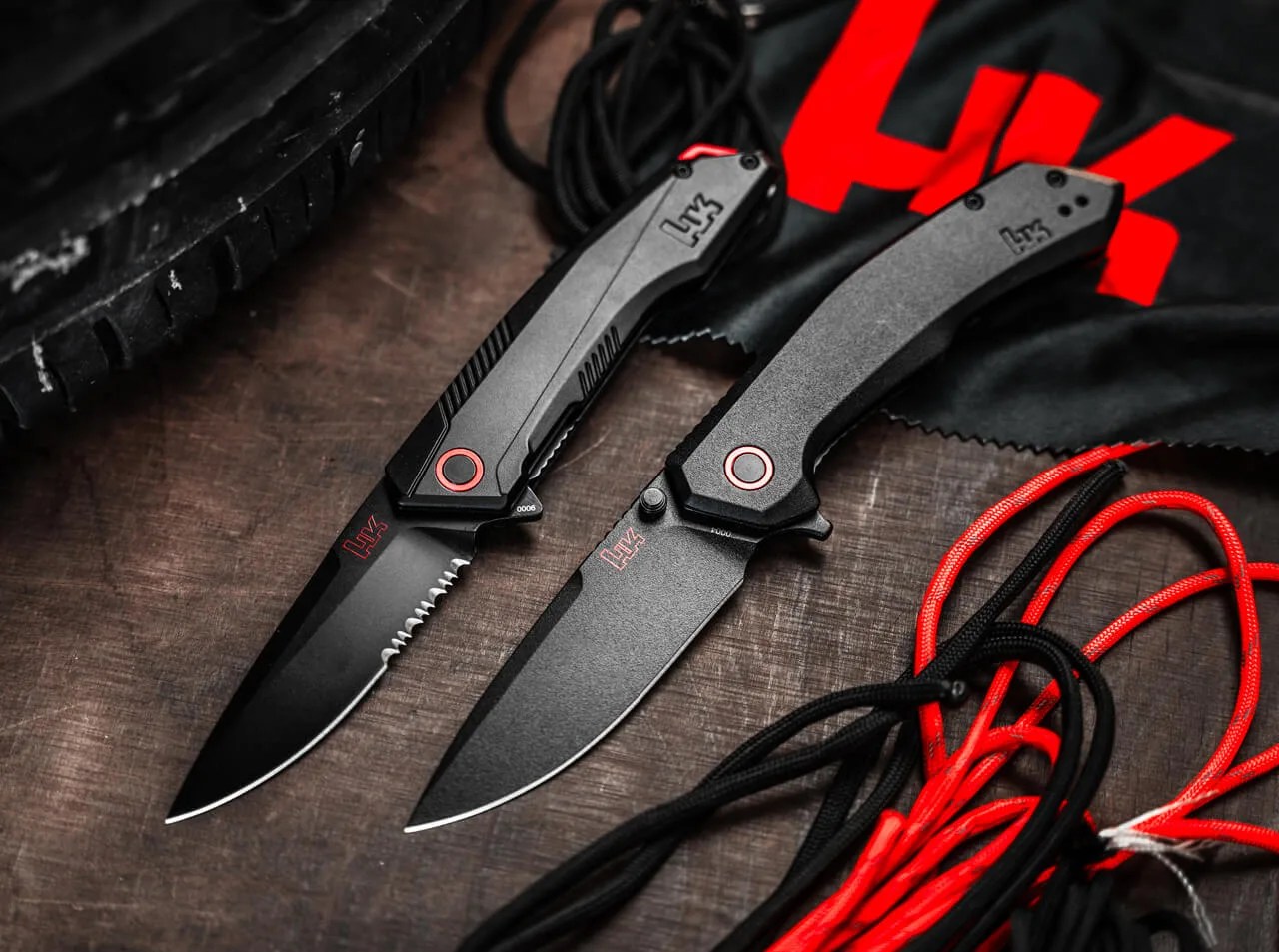
Böker has licensed the Heckler & Koch name for years, and the Oberndorf connection gives these knives a specific identity: tactical, German-engineered, priced for people who will never buy a $300 H&K-branded anything. Both knives are available now, at $70 for the FD04 and $75 for the FD05.
Where the H&K pair wins
Cost per feature is the argument. For $70 to $75 you get a D2 drop point with a swedge, a titanium-style coating, aluminum scales, a liner lock and a right-handed tip-up clip. On the FD04 that package includes a spring-assisted rear flipper and a partially serrated edge. The FD05 trades the spring for ambidextrous thumb studs, a rear flipper and a full plain edge, with the lanyard hole hidden at the rear of the handle instead of punched through the backspacer.
Against Böker's own Kalashnikov line, the closest in-house comparison, the value gap is stark. The Kalashnikov AK-101 2.0 runs the same formula, D2 on aluminum with a flipper and a liner lock, in a much bigger body: a 4.01-inch blade and 7.13 ounces at an MSRP of $139.95. The FD04 weighs a fraction of that, carries a 3.23-inch blade that clears most municipal limits, and costs half.
The FD05's manual deployment is also a quiet advantage. Spring-assisted knives sit in a legal gray zone in some jurisdictions, and a buyer in one of those places can pick the FD05 and lose nothing but the spring.
Where it gives ground
Steel. D2 is a semi-stainless tool steel from the 1960s. It holds an edge well and machines cheap, which is why it appears on every sub-$80 tactical folder, but it needs oiling and it will spot if the coating wears through. Kershaw's Bel Air, at $84, ships MagnaCut and a crossbar lock for nine dollars more than the FD05.
Weight and feel. Aluminum handles keep cost down but read hollow next to G10 or Micarta at the same price. Neither Böker USA nor Gear Patrol has published a weight figure for either model yet.
Handedness. The FD04's clip is right-handed tip-up only. Left-handed buyers get one option here, the FD05 with its ambidextrous studs.
Branding math. The H&K logo is worth real money to some buyers and nothing to others. Strip it and these are $50 Böker Plus knives, which is essentially what they are under the paint.
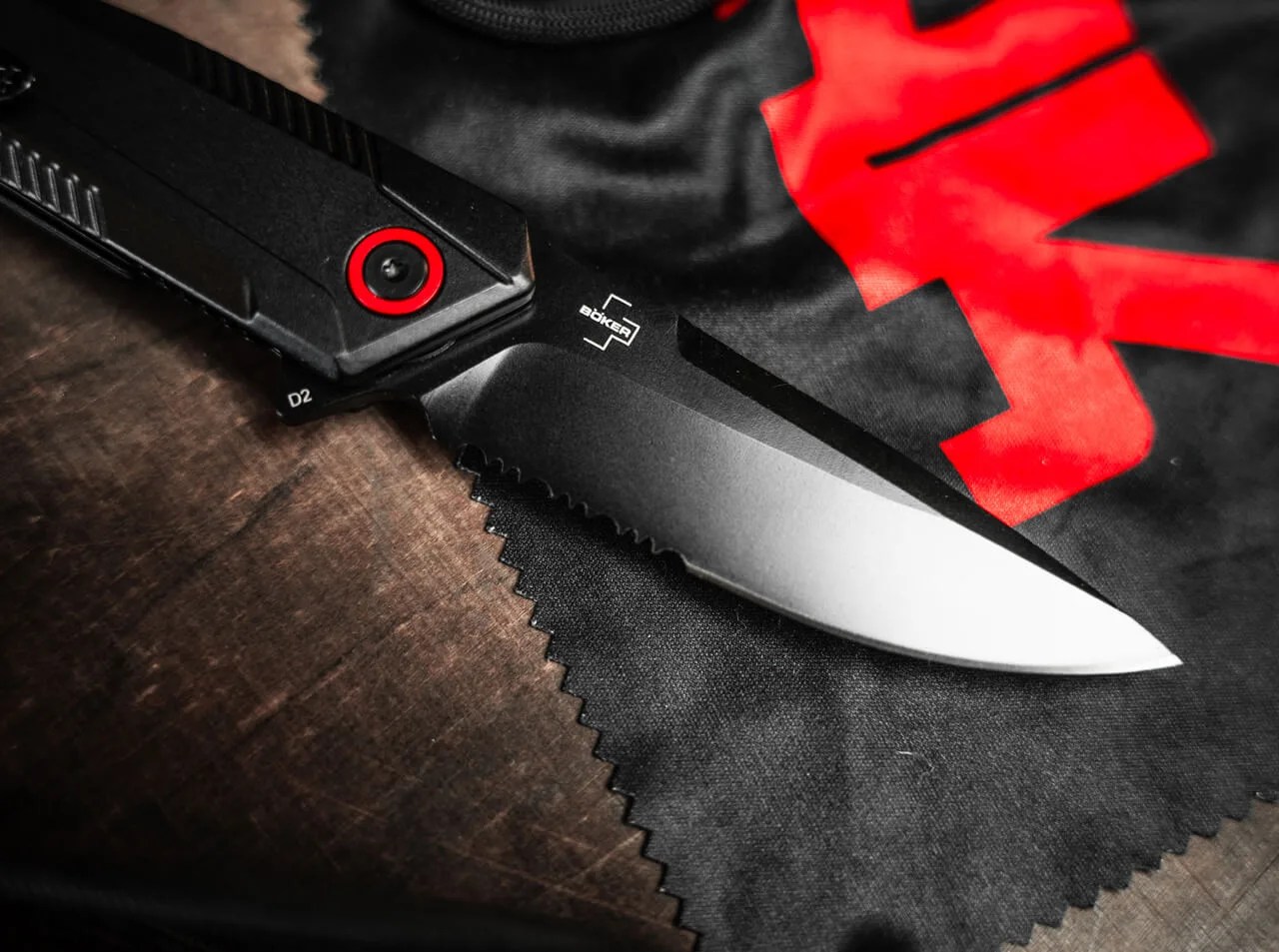
The serration split is the interesting product decision. Partial serrations have mostly disappeared from mainstream EDC because reviewers dislike them, but the FD04 keeps a run of them on the front third of the blade, where they bite cord and webbing. The FD05 commits to a plain edge and targets the buyer who sharpens. Two knives, one platform, no overlap between them.
What happens next depends on the winter sell-through. If the licensed tactical tier keeps moving at $70, expect Böker to extend the FD platform the way it extended Kalashnikov: more finishes, a Damascus or gold limited run, and eventually an OTF, because the H&K license has never been about restraint.