The Kershaw Bel Air 6105 has spent the past few weeks being recommended to anyone shopping for an American-made everyday folder, and a new review from KnifeInformer's Wayne Walter explains why: a 3.1-inch CPM MagnaCut blade at a published 62-64 HRC, a 2.9-ounce aluminum frame, Kershaw's DuraLock crossbar, and a street price around $150. The reviewer's conclusion is that it edges out the Hogue Deka, which had been his benchmark in the category, and beats the Benchmade Bugout outright.
What the Bel Air Actually Is
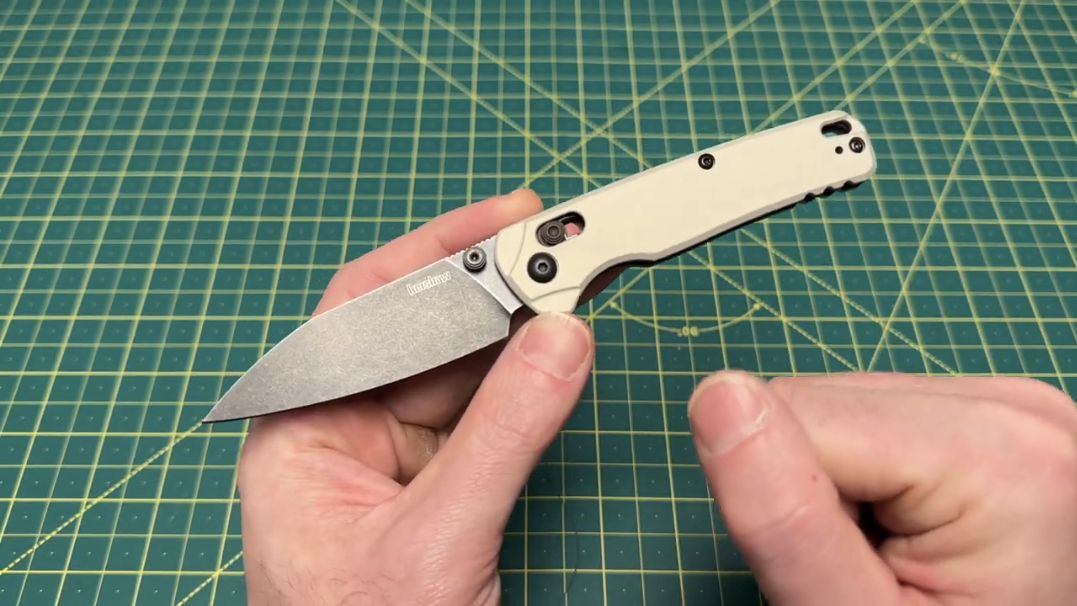
The 6105 is the aluminum-handled version, finished with a bright nickel Cerakote over 6061-T6 and fitted with a BlackWash blade. Kershaw's published figures put overall length at 7.3 inches, closed length at 4.2 inches, blade stock at 0.09 inch (2.3 mm), and handle thickness at 0.44 inch (11.2 mm). The blade is a reverse tanto — close enough to a modified wharncliffe that reviewers use both terms — with a full flat grind and a straight-ish edge that terminates in a reinforced tip.
Deployment is manual, via thumb studs on KVT ball bearings. That detail matters in a market where assisted opening is still common in $150 knives: the Bel Air is not an assisted knife, and the review treats that as a virtue rather than a compromise.
Blade: 3.1 in CPM MagnaCut, 62-64 HRC, 0.09 in stock
Handle: 6061-T6 aluminum, bright nickel Cerakote, 0.44 in thick
Lock: DuraLock crossbar, manual action
Carry: reversible deep-carry clip, right or left hand, tip-up
Weight: 2.9 oz — Origin: designed and made in the USA
Where Reviewers Land
Three details recur in the coverage. The first is blade geometry. A 0.09-inch full flat grind on a 3.1-inch blade is thin by modern folding-knife standards, and thin stock is what separates a knife that slices from one that splits. The review describes it as “a very thin, slicey blade,” and notes that it measures thinner than the Deka's stock even though the difference is not dramatic on paper.
The second is the pocket clip. It looks conventional but sits unusually deep, leaving only its top visible above a pocket seam — the kind of detail that never appears in a spec table yet shapes daily carry more than an extra point of hardness.
The third is a criticism: there is no real finger choil, so the index finger sits further from the edge than on a Para 3 and choking up for detail work is limited. The Deka has the same gap, but the Para 3 is clearly better here.
The Comparison That Matters
Four knives define this bracket: the Bel Air, the Hogue Deka, the Benchmade Bugout and the Spyderco Para 3. The review ranks them in that order, putting the Bugout last despite praising the Para 3's ergonomics.
The Bugout's weakness is instructive. Benchmade's knife is lighter at 1.85 ounces, but its action varies unit to unit and its thin handles have drawn consistent complaints. The Bel Air gives up roughly an ounce and gains a stiffer frame, a consistent crossbar and a tougher steel — the right trade for most carry.
Against the Deka the margin is narrower: both are American-made crossbar knives available in MagnaCut. Kershaw wins on blade stock and clip depth, Hogue on aftermarket support and track record. Anyone who already owns a Deka has little reason to switch.
What It Means for Buyers
MagnaCut at 62-64 HRC in a $150 American knife is the headline, and it is not marketing arithmetic. Crucible designed the steel to combine near-stainless corrosion resistance with tool-steel toughness, and it has held up under independent testing. Pairing it with thin stock is the correct application: toughness matters most when there is little material behind the edge.
The practical caveat is price drift: street prices for the aluminum 6105 have moved since launch, so check current listings rather than assume $150 holds. Other handle materials in the line change both weight and cost.
The larger point is competitive. A sub-3-ounce American crossbar folder in a premium powder-metallurgy steel at this price was recently an anomaly. It is now the baseline, and Kershaw — long associated with budget knives — is the one setting it.
The Verdict
The Bel Air is not a dramatic knife. It is a thin, light, well-executed crossbar folder with a steel that suits its geometry, and its best feature is the least glamorous: a clip that keeps it out of sight. The missing finger choil is a real limitation, and anyone who prioritizes ergonomics should try a Para 3 first.
For everyone else, the Bel Air is the current answer in the $150 American EDC bracket. It is available now through Kershaw dealers and major retailers, with the aluminum 6105 reviewed here typically listed around $150.